
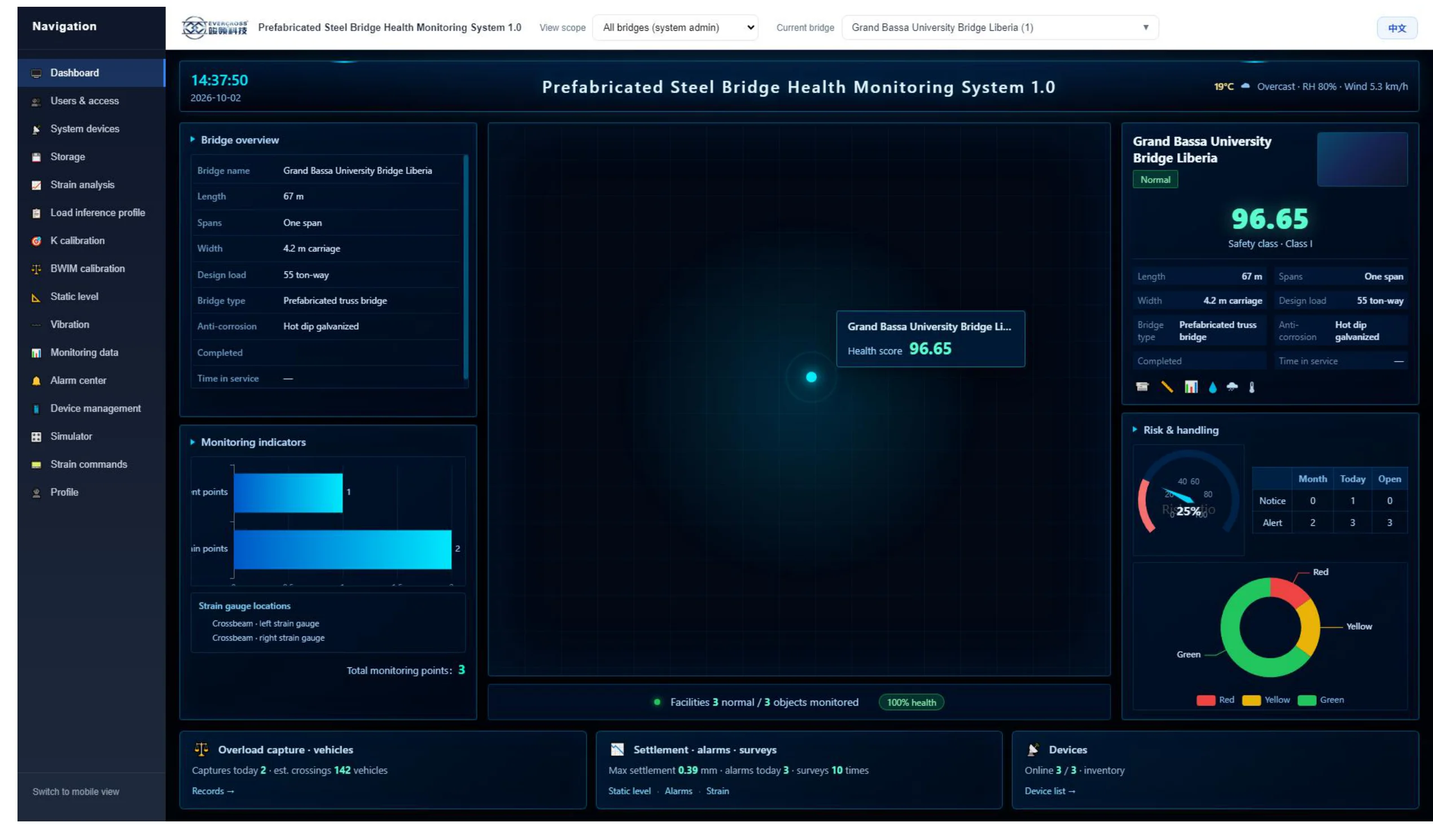
The EVERCROSS Bridge Health Monitoring System is a big-screen visualization platform that supervises the structural and operational condition of rapid-assembly prefabricated steel bridges in real time. Data perception, structural analysis and alarm management are integrated in a single panel: a lightweight, low-cost solution that is easy to operate for bridge owners, road agencies and contractors.
Core functions
Unified management panel
Main dashboard with a global view of every monitored bridge; role-based user access; online status, inventory and configuration of all sensors; centralized reception and handling of alarms.
Structural monitoring
Technical summary of each bridge (length, spans, width, design load, anti-corrosion protection). Strain gauges on the main girders track deformation in real time with full history; vibration monitors the dynamic response; settlement control is linked to alarms and field inspections.
Health evaluation & risk management
A single health score with classification (Normal / Safety class) summarizes the structural state. Visual risk-level indicator, green-yellow-red distribution of measuring points, and an alarm log by month, current day and pending resolution.
Load & traffic surveillance
Load-inference profile estimates the real loads crossing the bridge. BWIM weigh-in-motion identifies vehicle weights in motion (K calibration), and overload capture registers crossings with automatic detection of overweight vehicles.
Environment & operation
Real-time weather data (temperature, humidity, wind) correlates structural behaviour with environmental conditions. Monitoring history storage and query, plus a simulator and deformation commands for testing, calibration and scenario simulation.
Key advantages
- Lightweight, low-cost deployment — runs with a minimum number of sensors, reducing investment, installation and maintenance compared with massive traditional monitoring systems.
- Specialized for rapid-assembly prefabricated steel bridges — designed around exactly the panel bridges we manufacture, including emergency and rapid-deployment projects.
- One-number evaluation — the health score turns complex technical data into an immediate, understandable conclusion for non-specialized managers.
- Everything in one panel — structural state, deformation, vibration, settlement, loads, alarms and weather presented in a unified view, with no scattered information.
- Proactive risk management — alarm statistics and the alarm registry detect anomalies in time, before they grow into major failures.
- Overload protection — the BWIM function identifies overloaded vehicles in transit, protecting the structure from damage caused by misuse.
- Correlation with the environment — real-time weather data makes it easy to analyse the influence of climate on steel bridge behaviour.
- Scalable and multi-bridge — several structures can be monitored simultaneously, with users, devices and inventory managed from the same platform.
- Interface in the language you specify — the interface language is configurable at deployment (multilingual support), with a mobile-adapted view, ready for international operation scenarios.
Where it delivers the most value
The core value of the system is simple: monitor bridge health in real time, warn about risks early, make maintenance easier and keep the bridge used within its design limits. It suits permanent bridges under continuous observation just as well as rapid-deployment projects — and because the monitoring equipment is reusable, the same kit can move from one project to the next. Temporary and emergency bridges can of course benefit too. With its unified health score, early alarm levels and vehicle-overload detection, it delivers the maximum monitoring value with the minimum investment — closing the loop from delivery to decades of safe operation.