
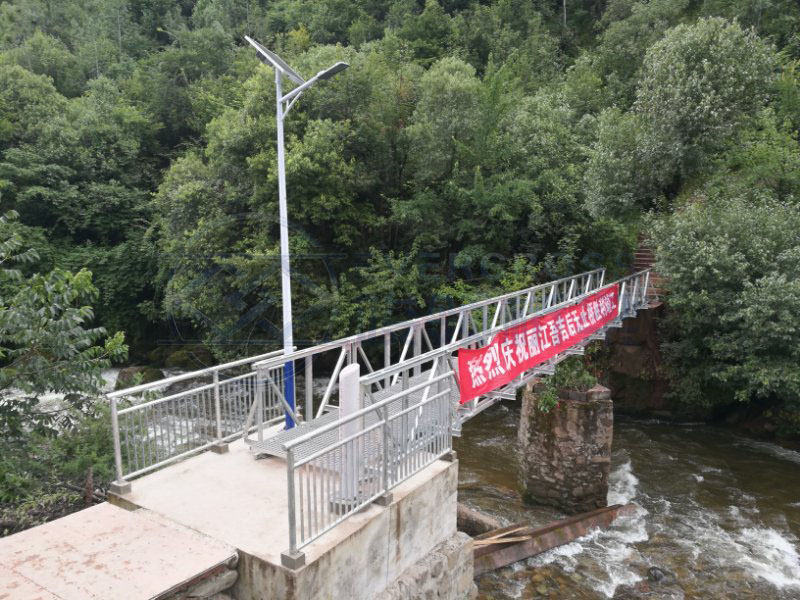

On the evening of 12 April 2025, thirteen solar street lamps came on along a mountain road in Dongchuan Village, Shaanxi that had never had light. The Bailey bridge at the village crossing and those poles share one origin: our workshop.
The village lies deep in the mountains of Shangluo. Houses are scattered across slopes too steep for vehicles; most young people have left for work, and those who stay are largely elderly. After sunset there was no public lighting at all — people walked with flashlights and would not go out alone. Access here is not an abstract indicator: it is a river to cross to reach school, a path to walk after dark.
Thirteen Lamps in One Day
From 11 to 13 April, the “Heart Bridge Without End” team of Xi’an Jiaotong University and the Hong Kong Wu Zhi Qiao (Bridge to China) Charitable Foundation ran the “Wu Zhi Lamp” programme there, organised by Mr Yang Lu of XJTU and guided by senior volunteer Mr Stephen and Mr Chang Zhuqing, with five XJTU volunteers, a Hong Kong University intern and villagers. They lodged in a disused primary school and worked to one deadline: everything lit before sunset.
Poles and components went up the footpaths by handcart; foundations were set with expansion bolts, cables threaded through the masts, panel tilt aligned to the local solar elevation angle so the lamps would charge through short winter days. Masts were raised by hand, bolt by bolt, and each lamp commissioned after dark. By the end of day one, thirteen lamps were burning.
The Poles Came From the Same Workshop as the Bridge
All thirteen poles were donated free of charge by Zhenjiang Great Wall Heavy Industry Co., Ltd., parent manufacturer of EVERCROSS BRIDGE TECHNOLOGY (SHANGHAI) CO., LTD. — and the factory that fabricated the Bailey bridge at the village crossing. Luminaires came with the support of Mr Chen Yuhu of Jiangsu Yichuang Lighting Group.
That is the point. What a bridge manufacturer can usefully give is rarely a cheque; it is what it knows how to make — steel still standing after twenty monsoon seasons, sized to go up a footpath on a shoulder, detailed so a volunteer with a spanner can build it in an afternoon.
Inspecting Our Own Work
On day two the team inspected the bridge — connections, panel alignment, deck condition, behaviour under pedestrian load — and asked villagers how it is used and what they made of the lamps. On every Wu Zhi Qiao site we are involved in, a bridge is not finished at handover; it is finished when it has been inspected, used and inspected again.
Fourteen Years of Wu Zhi Qiao
The foundation was established in 2007, building pedestrian bridges for remote mainland communities with Hong Kong and mainland students and technical backing from industry. EVERCROSS and its parent factory have supported that model since its early years — responsible not for a logo on a banner but for the structure.
Our Yunnan project, completed in August 2017, shows the workload behind a “small” bridge: after two site surveys the team settled on a steel Bailey solution — a 32-metre main span across a 28-metre channel, on the route children had walked over a dilapidated old bridge or waded. It went up in ten days, after our engineers optimised details and revised the drawings against the surveyed topography and river conditions.
Engineering for People, Not Vehicles
A Wu Zhi Qiao is a footbridge, which changes the brief. Our Light Bailey Bridge 2.0 raises panel height from 1.0 m to 1.2 m for a parapet that suits children and elderly users; simplifies connections so volunteers can assemble it with hand tools; replaces the solid deck with a grid deck that stops soil build-up and rain-slipperiness; and holds component weights within hand-carried limits, because the last kilometre is always on foot.
What We Will Donate, and to Whom
This is a programme, not a gesture. EVERCROSS is prepared to donate, free of charge, solar lighting sets and Wu Zhi Qiao pedestrian Bailey bridges — including to herdsmen and pastoral households whose winter and summer pastures are separated by a stream with no crossing, and whose settlements have no public lighting.
What we offer is the chain rather than a shipment: site survey and a scheme matched to span, banks and flood level; design and shop drawings; fabrication in our own workshop with hot-dip galvanising; packing for hand-carried and pack-animal transport, numbered to the erection sequence; plain-language manuals; remote and, where possible, on-site support.
If your village, school, clinic or pastoral community needs a crossing or lighting that no budget covers, write to us with the span, the banks, the water and the number of people who would use it. We will tell you honestly whether we can build it — and if we can, we will.